AI Website Builder vs Hiring a Developer in 2026: A Genuine Cost Breakdown
Rajesh P
March 30, 2026 · 9 min read
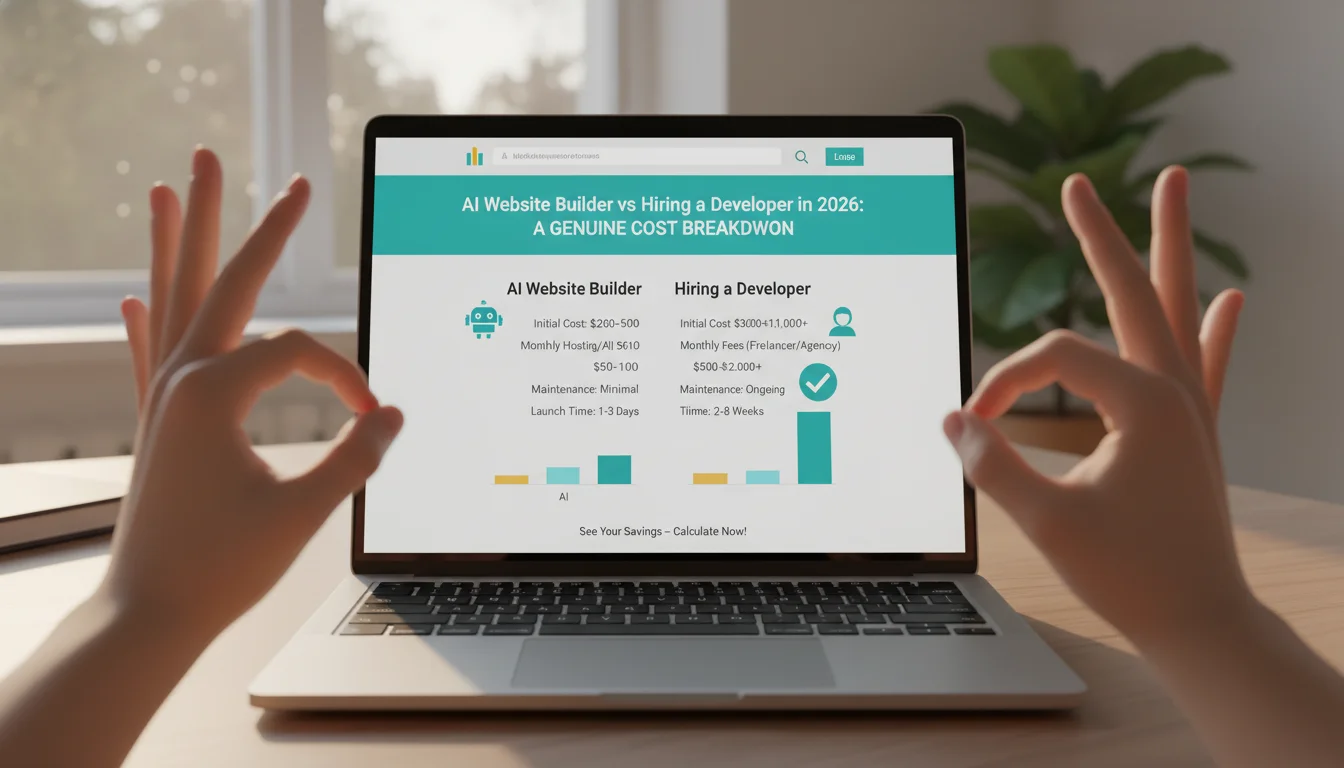
The developer gave you a quote of $4,500. The agency came in at $18,000. The AI builder's homepage says 30 minutes. You are trying to figure out which number is real and which is a trap.
All three numbers are real. None of them tell the whole story. What actually matters is the total cost of ownership over twelve months, not the number on the first invoice. That calculation looks very different depending on what you are building, how often it will change, and how technical you are.
The developer path: what you actually pay
A freelance developer for a small business website or ecommerce store typically costs between $2,500 and $15,000 upfront, depending on complexity and where the developer is based. A US-based developer with a solid portfolio charges more like $8,000 to $20,000 for a complete store. An agency adds process, project management, and a brand markup that pushes the same scope to $20,000 to $60,000.
Ecommerce Store Builder
Build it with CodePup AI. Ready in 30 minutes.
Those are the headline numbers. Here is what most people do not budget for.
Revisions. Every change request after the initial build is typically billed at $75 to $150 per hour. Changing the layout of a page, adding a new product category, updating the checkout flow to handle a new product type. None of that is covered in the original quote. Three rounds of revisions on a $6,000 build can easily add $1,500 to $3,000.
Timeline slippage. The average freelance web project runs 40% over its original timeline according to project management data. A six-week project becomes ten weeks. If you are waiting on a website to launch your business or your product, that slippage has a real cost that never appears on an invoice.
Maintenance retainer. After launch, your developer is not free. Bug fixes, security updates, plugin updates if you are on WordPress, hosting issues, anything that breaks. Most developers charge a monthly retainer of $200 to $800 for basic maintenance. That is $2,400 to $9,600 per year on top of the original build cost.
The AI builder path: what you actually pay
Most AI builders charge a monthly subscription of $20 to $50, plus some form of credit or token system for generation. The monthly cost looks trivial. The real cost is in the credit consumption model.
If your AI builder generates iteratively, meaning you prompt for one section, review it, prompt for the next, each step consumes credits. A multi-page store on this kind of builder can consume 300 to 800 credits before it is complete. When revisions cause regressions and you have to regenerate sections, credit consumption compounds fast. Founders routinely report spending $150 to $400 in credits to build something that the pricing page implied would cost $30.
Platform lock-in is the other cost that does not show up on the invoice. If your site lives on a proprietary AI builder platform, you cannot easily move it. You are paying their monthly fee as long as you want the site to exist. The economics of that fee compound over three or five years in a way that makes the upfront developer cost look more competitive than it first appeared.
The AI builder that generates your entire site at once, rather than section by section, changes this calculation significantly. One prompt, all pages, no credit-per-revision spiral. The math looks very different.
Where the gap between developer and AI has genuinely closed
Three years ago, AI builders produced things that looked roughly like websites but would not have survived real customer use. Broken checkout flows, inconsistent design across pages, authentication that failed on edge cases. The quality ceiling was low.
In 2026 that has changed for the standard use cases. A ecommerce store for physical products, a service business website with booking, a digital products store with automated delivery, a portfolio with contact form. For these, a well-built AI builder produces output that is functionally equivalent to what a mid-tier developer would build. Not because AI got more creative, but because the test cases for these site types are well-understood and the AI has been trained on enough examples to get them right.
The key word is tested. An AI builder that ships untested code is still a liability, regardless of how good the generation quality has become. Browser-based automated testing, the kind that actually clicks every button and completes every checkout flow before delivery, is what separates production-ready AI output from a prototype that looks fine until a real customer uses it.
Where the gap has not closed
Custom business logic is still better served by a developer. If your checkout needs to calculate shipping based on live carrier APIs with custom rules for specific product combinations, that requires someone who can reason about edge cases in code and test them systematically. AI can write this but the reliability is not there yet for complex conditional logic.
Highly bespoke design is the same. If your brand differentiator is a specific visual experience that does not exist anywhere else, a developer working with a designer will outperform an AI builder. The AI produces good-looking, professional output. It does not produce things that have never been seen before.
Sensitive data handling and compliance requirements also still call for a developer. If you are handling medical records, financial data, or anything with specific regulatory requirements, you want a human who can take legal and technical responsibility for the implementation.
Four questions that tell you which path to take
Budget under $500 and timeline under a week: AI builder. A developer cannot start for this budget and you cannot wait for the timeline.
Standard use case (store, service site, portfolio, booking site) with no unusual custom logic: AI builder. The quality is there, the cost is significantly lower, and you get something live fast enough to start getting real customer feedback.
Complex custom requirements, ongoing development needs, or a team of developers who will own the codebase long-term: hire a developer. The upfront cost is higher but the flexibility and control are worth it for anything with serious technical complexity.
Uncertain which category you fall into: build with AI first. Get something live, get real feedback, understand what your customers actually need. Then invest in a developer to build exactly what the market is asking for, not what you imagined it might need.
The 30-minute claim is real for the right use cases. So is the $18,000 developer quote. The question is whether your use case is one where the difference in outcome justifies the difference in cost. For most standard websites and stores in 2026, it does not.
If you are in the AI builder category, the thing that determines whether you get a working site or a prototype is whether it gets tested before you see it. CodePup generates the entire site at once, tests every page and every user flow automatically, and delivers something you can put in front of customers the same day.
Ready to build this?
Start with a template built for your use case.
Ecommerce Store Builder
Launch a full ecommerce store in under 30 minutes. Describe your products once and CodePup generates the catalog, cart, Stripe checkout, order emails, and admin — tested before delivery and yours to own. No Shopify app stack, no monthly platform lock-in.
Start building →AI No-Code Website Builder
Build any website without writing a single line of code. CodePup AI generates production-ready websites from your prompt — complete with Stripe payments, user authentication, analytics, and event-driven emails, all tested and launch-ready.
Start building →More from the blog
Ready to build with CodePup AI?
Generate a complete, tested website or app from a single prompt.
Start Building