The Hidden Cost of Vibe Coding: Why AI Builders Feel So Expensive (And How to Fix It)
Rajesh P
January 24, 2026 · 8 min read
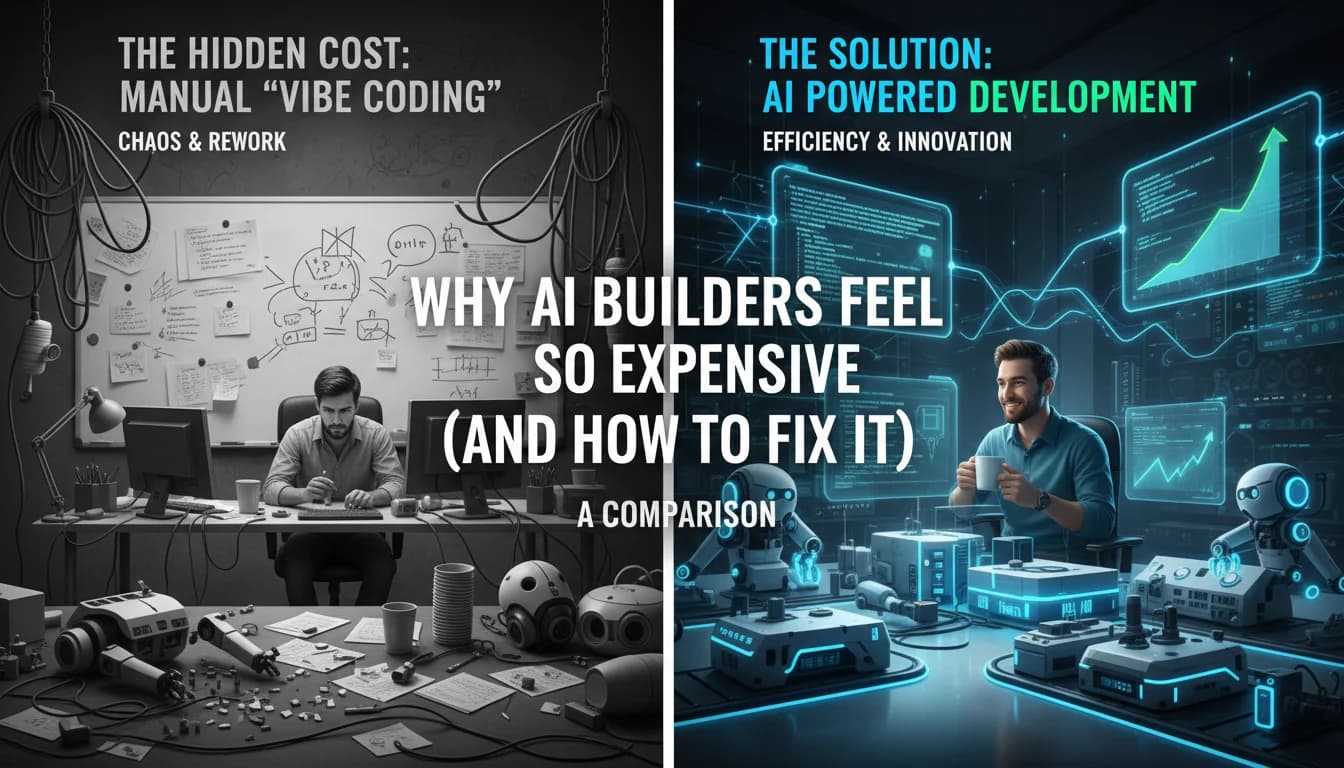
It was supposed to be a quick fix. Change the hero font, adjust some padding, maybe add a sticky navbar. Two hours and 160 credits later, you're staring at your billing dashboard wondering how tweaking CSS consumed the equivalent of half a month's subscription. If you've used Lovable, Bolt, or any credit-metered AI builder, this story sounds familiar.
The frustrating part isn't the bill. It's that you can't explain it. What did those 160 credits actually do? The platform doesn't tell you. And that opacity, it turns out, is both the product and the problem.
1. Break down where credits actually go
In most credit-metered AI builders, a "generation" is the unit of cost. But what counts as a generation is rarely defined. Ask for a navbar change: one generation. The AI misunderstands and rebuilds the entire hero: another generation. You correct it, it regenerates three components it didn't need to touch: three more generations. You've now spent five credits on a navbar color.
AI No-Code Website Builder
Build it with CodePup AI. Ready in 30 minutes.
The core problem is architectural. These platforms operate on a full-context, full-file model. When you ask for a small change, many of them rewrite the entire affected page rather than making a surgical edit. A multi-file refactor that should change four lines touches forty. Every regeneration of every component is a credit event. The AI's tendency to "fix" adjacent code it wasn't asked about compounds this further.
Real user story (Reddit, r/lovable, January 2026): "I asked it to center a button. It regenerated the entire page layout, broke my auth flow, and I spent 40 credits getting back to where I started."
Multi-file refactors are the worst offenders. When the AI decides a structural change requires touching your routing, your component library, and your data models simultaneously, you can watch triple-digit credit burns happen in a single session. Users on X have documented losing 200+ credits on what was described as a "simple checkout redesign" because the platform regenerated every downstream component that touched the cart state.
2. When the platform's bugs become your bill
The most corrosive dynamic in credit-metered building isn't the complexity tax. It's paying to fix bugs that the platform created. This happens in two ways: regression bugs introduced during generation, and platform migrations that break working code.
Regression bugs are endemic to how these systems work. The AI doesn't have a stable mental model of your codebase. It infers context from what it can see in the prompt window. When it regenerates a component, it frequently introduces subtle regressions in components that shared state. You then spend credits debugging a problem you didn't create.
Platform migrations are more insidious. When a provider updates its underlying model or changes how it handles state, projects built on older generations can silently break. Users report submitting refund requests for credits burned debugging post-migration regressions, only to receive partial refunds or outright denials. The implicit contract, "we broke it, we'll cover the cost to fix it", doesn't actually exist.
"After the model update, three pages stopped rendering. I spent 80 credits on fixes. Support said the credits were legitimately used so no refund. They were legitimately used fixing their update." — Bolt user, Discord, December 2025
This creates a genuinely adversarial dynamic. The platform profits from both the original generation and the remediation. There is no financial incentive to reduce regeneration scope or prevent regressions, because every fix is a billable event.
3. The psychology of opaque pricing
Here's a counterintuitive finding from behavioural economics: people consistently rate metered, unpredictable costs as worse than equivalent flat fees, even when the total spend is the same. The anxiety of not knowing what the next action will cost makes the product feel hostile, even when it's technically delivering value.
Credit-metered AI builders maximise this anxiety. There is no granular usage report that maps individual prompts to credit consumption. There is no pre-action cost estimate. There is no cap per session. Every prompt is a gamble with an unknown stake, and the interface is designed to encourage you to prompt more, not less.
- No pre-action cost estimate: you don't know what a prompt will cost before sending it
- No granular usage log: you can't trace which prompt consumed which credits
- No session cap: a single debugging loop can consume a month's allocation
- No explore mode: experimenting costs the same as deploying
- Refund policies are discretionary, and platform-caused bugs may not qualify
The result is a product that trains users to be afraid of it. You start second-guessing prompts. You write longer, more defensive prompts trying to prevent expensive regenerations. Ironically, longer prompts often trigger broader context reloads and cost more. The system is self-defeating for the cautious user.
4. Design principles for a trustable credit system
The current model isn't inevitable. It's a design choice. Here are the principles that a trustable credit system would actually follow:
- 1Don't charge for known-bad outputs. If the AI generates something that fails its own validation, the credit should be returned automatically. A broken build should not be a billable event.
- 2Show real-time credit burn before the user commits. A cost estimate, even an approximate one, before executing a generation fundamentally changes the user's relationship with the tool.
- 3Cap costs per session. A session ceiling prevents the worst-case runaway scenarios. Users will pay more predictably over time if they trust they can't accidentally overspend in one session.
- 4Separate explore mode from deploy mode. Experimenting with layout or copy changes should cost less than deploying to production. These are meaningfully different operations with different stakes.
- 5Platform regressions are platform costs. If a model update breaks a previously working project, remediation credits should be covered. Full stop.
None of these are technically difficult to implement. They're absent because the current model is more profitable. But they would produce a dramatically higher retention rate and better long-term unit economics. Users who trust the pricing system spend more over time.
5. How CodePup thinks about cost and transparency
CodePup is designed for a specific domain, websites and ecommerce, and that constraint actually produces better cost predictability. A focused scope means fewer wildcard generations. When you're building a store or a marketing site, the solution space is well-understood, and the AI doesn't need to "explore" the problem the way a general-purpose builder does. Generations are more targeted, with less collateral.
More importantly, CodePup bakes automated testing into every build. Every generation is validated before you see it: unit tests, integration tests, and E2E flows run automatically. This means you don't pay to discover that the generation was broken. A generation that fails its own tests is not a successful generation.
The goal isn't to be the cheapest AI builder. It's to be the one where the bill makes sense at the end of the month. Where you can trace what happened and why, and where you're not paying for the platform's mistakes. That's not a pricing feature. It's a respect for the user's money.
The vibe coding promise was always "build anything fast." The hidden cost was always the correction loop. Building less broadly, but more reliably, is the only way to actually deliver on that promise.
Ready to build this?
Start with a template built for your use case.
More from the blog
Ready to build with CodePup AI?
Generate a complete, tested website or app from a single prompt.
Start Building