How to Sell Online Without Shopify (And Save 80%)
Rajesh P
March 31, 2026 · 9 min read
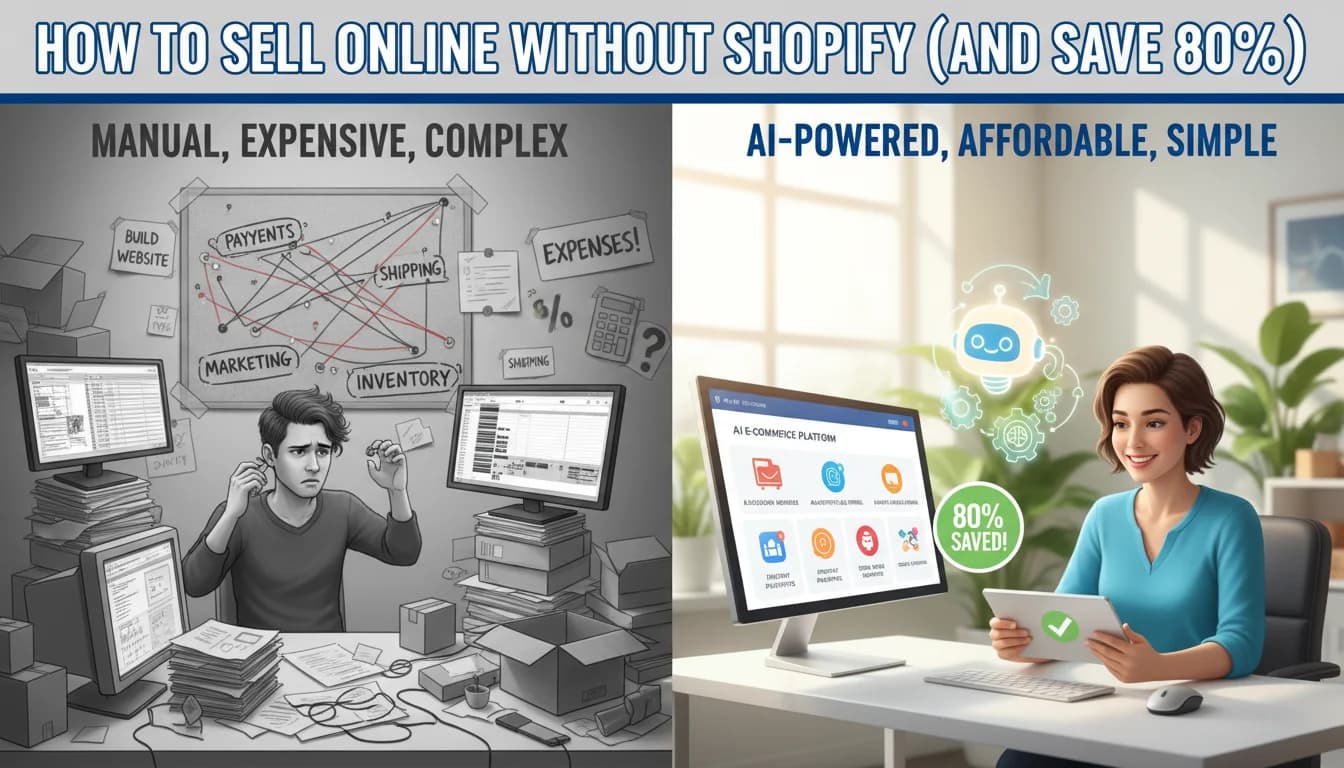
I talk to founders every week who are paying Shopify $150 to $300 a month for a store that sells fewer than 50 products. They signed up for the $39 Basic plan. Then they needed a reviews app, an email capture popup, a better theme, an SEO plugin, and an upsell widget. Each one added $10 to $30 per month. By the time they realized what was happening, their ecommerce costs were eating into margins they hadn't even built yet.
The question I hear most often: can I sell online without Shopify? The answer is yes. And for most small businesses, the savings are around 80%.
Why People Want to Leave Shopify
It usually starts with the monthly bill. You open the Shopify admin, look at your app subscriptions, and realize you're paying more in platform fees than you spent on inventory last month. The $39 plan was the hook. The app ecosystem is where Shopify actually makes its money from small merchants.
Ecommerce Store Builder
Build it with CodePup AI. Ready in 30 minutes.
Then there's the theme problem. Free Shopify themes look like free Shopify themes. Your store looks identical to thousands of others. Premium themes cost $150 to $350 and still need a page builder app to customize properly. That's another $12 to $15 per month.
The plugin dependency is the worst part. Shopify deliberately leaves standard ecommerce features out of the core product so you pay for them through apps. Product reviews, email popups, bundle discounts, size guides, countdown timers. These aren't exotic features. Every store needs them. But on Shopify, each one is a separate monthly subscription.
The Real Monthly Cost of Shopify for a Small Business
Let me break this down with real numbers. I've seen dozens of Shopify invoices from founders in my cohort. The pattern is almost always the same.
- Shopify Basic plan: $39/month
- Email marketing app (Klaviyo or similar): $20/month
- Product reviews app (Judge.me or Loox): $15/month
- SEO optimization app: $10-20/month
- Upsell/cross-sell app: $15-30/month
- Page builder for theme customization: $12-15/month
- Transaction fees (2% on non-Shopify Payments): $60-100/month on $3K-5K revenue
Total real cost: $171 to $289 per month. That's $2,052 to $3,468 per year for a store that might be doing $3,000 to $5,000 a month in revenue. You're spending 4-8% of gross revenue on platform costs alone.
What You Actually Need to Sell Online
Strip away the Shopify marketing and ask a simple question. What does a working online store actually require?
- 1Product pages with images, descriptions, pricing, and variants
- 2A shopping cart that works on mobile and desktop
- 3A checkout flow connected to a real payment processor
- 4Order confirmation emails to the customer
- 5A way to manage products and view orders
- 6Basic SEO so your products show up in search
That's the complete list. Six things. Every feature beyond this is either a nice-to-have or something you can add later when revenue justifies it. You don't need a loyalty points system when you have 200 customers. You don't need a wholesale channel when you're selling direct to consumers from your kitchen table.
Alternative Approaches to Selling Online
WooCommerce (WordPress)
WooCommerce is free and open source. That sounds great until you factor in what it actually takes to run it. You need hosting ($10-30/month for something that doesn't crash under traffic). You need to manage WordPress updates, plugin conflicts, and security patches. Most non-technical founders end up hiring a developer for $50 to $100/hour to fix things that break. WooCommerce is free like a puppy is free.
Squarespace Commerce
Squarespace Commerce starts at $33/month. The templates are beautiful. But the ecommerce functionality is limited compared to what most stores need. No real app ecosystem to fill the gaps. If your store is simple, a dozen products with no variants, Squarespace works. The moment you need anything custom, you hit a wall.
Big Cartel
Big Cartel is designed for artists and makers. Free for up to five products, $15/month for 500. It's genuinely simple and affordable. The tradeoff is that it's basic. Limited design options, no built-in email marketing, minimal analytics. Good for selling prints at a craft market. Not enough for a growing business.
AI Store Builders
This is the category that didn't exist two years ago. AI builders generate a complete, functional store from a description. You say what you sell, how your products are organized, and what your brand looks like. The builder creates product pages, cart, checkout, and payment processing in one pass. No templates. No plugins. No monthly app fees stacking up.
How AI Builders Change the Equation
The fundamental problem with Shopify and its competitors is the platform model. You rent space on their infrastructure. They charge you monthly. They take a cut of every sale. They keep core features behind a paywall so you buy apps. The incentives are designed to extract maximum revenue from you over time.
AI builders flip this. Instead of renting a platform, you get a store built for you. The code is yours. The features are built in from the start, not bolted on as $15/month subscriptions. Payment processing goes through Stripe directly into your account. No middleman taking a platform cut.
The practical difference is that your monthly cost drops from $150-300 to roughly $25-30. That's it. No app stack. No theme fees. No platform transaction surcharge.
The CodePup Approach: $25/Month, Everything Included
I built CodePup to solve this exact problem. You describe your store in plain English. CodePup generates the entire thing. Product catalog, shopping cart, checkout, Stripe payment integration, order confirmation emails. All connected and working when you get it.
Stripe is wired in directly. Customers pay through Stripe's checkout. Money goes into your Stripe account. CodePup sets up the webhook handling so order confirmations fire automatically when a payment succeeds. No platform transaction fee on top of Stripe's standard 2.9% + 30 cents.
The flat cost is $25/month. That covers hosting, the store, and updates. No app subscriptions for reviews, email capture, or SEO. Those features are built into the store from day one.
The 80% Savings Math
Let me lay this out side by side for a store doing $4,000/month in revenue.
Shopify: $39 (plan) + $70 (apps) + $80 (2% transaction fees on $4K) = $189/month, or $2,268/year. CodePup: $25/month flat = $300/year. Same Stripe processing fees either way. Annual savings: $1,968. That's an 87% reduction in platform costs.
Over three years, that's nearly $6,000 you keep instead of sending to Shopify. For a small business with tight margins, $6,000 buys real inventory, actual ad spend, or a few months of runway.
How to Migrate from Shopify to Your Own Store
If you're currently on Shopify and want to move, here's the process.
- 1Export your product data from Shopify (Settings > Export in the Products section). You'll get a CSV with all your products, variants, prices, and descriptions.
- 2Download all your product images from Shopify's CDN. Your product export includes image URLs. Save them locally.
- 3Describe your store to CodePup. Include your product categories, brand colors, and how you want the store organized.
- 4Review the generated store. Check product pages, test the cart, run through checkout with Stripe's test mode.
- 5Point your domain to the new store. Update your DNS records. This takes 5 minutes if you own your domain.
- 6Cancel your Shopify subscription and all app subscriptions. Do this after your new store is live and tested.
- 7Set up Stripe to receive real payments. If you already have a Stripe account from Shopify Payments, you're done.
The whole migration takes a day. Most of that time is reviewing the new store and testing checkout. The actual build happens in minutes.
When Shopify IS Worth the Cost
I'm not going to pretend Shopify is wrong for everyone. It's worth paying for in specific situations.
- You're doing $500K+ per year in revenue and need advanced inventory management across multiple locations
- You rely on Shopify POS for physical retail locations
- You need complex integrations with fulfillment centers, 3PLs, or ERP systems that have native Shopify connectors
- Your team is trained on the Shopify admin and the switching cost in productivity would outweigh the savings
- You're using Shopify's wholesale channel or B2B features
If three or more of those apply to you, stay on Shopify. The platform cost is justified by the infrastructure you're actually using. But if none of them apply, and you're a founder selling 20 to 200 products direct to consumers, you're overpaying by a wide margin.
Start Selling Without the Platform Tax
Shopify built a great business by making ecommerce accessible. But accessible doesn't mean affordable. For small businesses, the real cost of Shopify has grown every year as the app ecosystem has expanded and the platform has added more pricing tiers.
You can sell online without Shopify. You can have a complete store with payments, product pages, and a working checkout for a fraction of the cost. The tools exist now. They didn't three years ago.
Ready to build your store without the Shopify tax? CodePup generates a complete ecommerce store with Stripe payments, auto-testing, and no monthly app fees. Start at codepup.ai/launch/ecommerce-store-builder
Ready to build this?
Start with a template built for your use case.
Ecommerce Store Builder
Launch a full ecommerce store in under 30 minutes. Describe your products once and CodePup generates the catalog, cart, Stripe checkout, order emails, and admin — tested before delivery and yours to own. No Shopify app stack, no monthly platform lock-in.
Start building →AI Online Store Builder
Launch your online store in minutes. CodePup AI builds your product catalog, shopping cart, Stripe checkout, and customer account portal — fully tested and ready to sell from day one.
Start building →Dropshipping Store Builder
Launch a branded dropshipping website today. Describe your niche and the builder generates a complete store — product pages, cart, Stripe checkout, and supplier-ready layouts for AliExpress, CJ Dropshipping, or Zendrop — fully tested and live in minutes.
Start building →More from the blog
Ready to build with CodePup AI?
Generate a complete, tested website or app from a single prompt.
Start Building