You're Paying Shopify $2,900 a Year. Here's What You Actually Need.
Rajesh P
March 30, 2026 · 7 min read
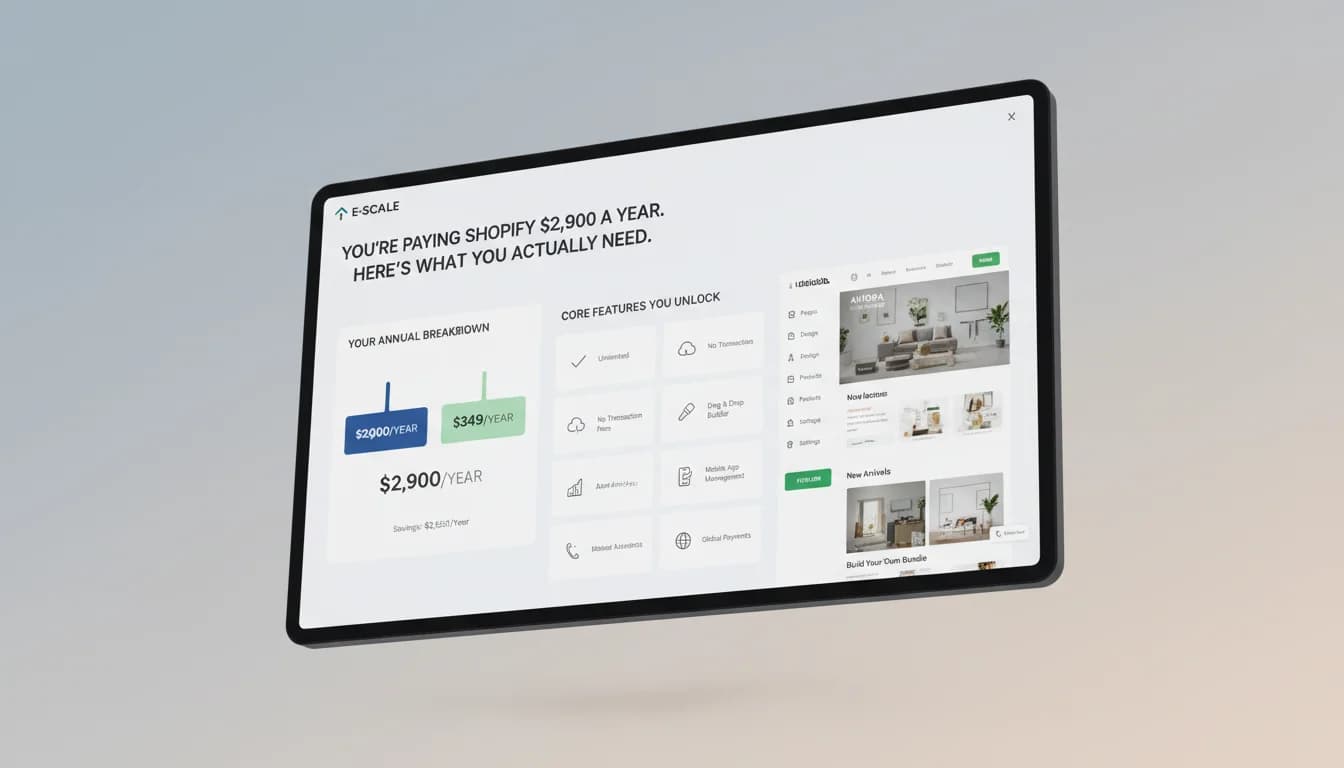
The Shopify pricing page shows $39 a month for the Basic plan. That number is real. It's also not what you actually pay. Most Shopify merchants end up spending significantly more once you account for what the platform doesn't include. The apps, the transaction fees, the theme. Add it all up and the first year on Shopify costs between $2,900 and $3,700. Over three years, you've spent $8,700 or more and you own none of it.
This isn't a hit piece on Shopify. For a certain type of seller, one doing meaningful volume, using Shopify's advertising ecosystem, or needing its app integrations, Shopify is worth the cost. But for the typical small business owner running a standard store with a product catalog, a cart, a checkout, and some email automation, there's a compelling case for a different approach. Here's exactly what you're paying and what you actually need.
The Real Shopify Bill: Line by Line
Start with the base plan. Shopify Basic is $39 a month, or $468 a year. That buys you the storefront, hosting, and basic checkout functionality. It doesn't buy you a professional theme, it doesn't include the apps most stores need to function properly, and it charges you transaction fees on every sale unless you use Shopify Payments.
Ecommerce Store Builder
Build it with CodePup AI. Ready in 30 minutes.
Transaction fees are often the biggest hidden cost. On the Basic plan, if you use any payment processor other than Shopify Payments, Shopify charges 2 percent of every transaction as a platform fee. On $5,000 a month in sales, that's $100 a month, $1,200 a year, just in platform fees on top of the normal payment processing charges.
Themes. The free Shopify themes are functional but immediately recognisable as free Shopify themes. Most merchants who care about their brand spend $140 to $350 on a premium theme. One-time cost, but real.
Apps. This is where the bill climbs fastest and most invisibly. Shopify's core functionality doesn't include: a product review widget, email marketing, a pop-up for email capture, upsell and cross-sell prompts, loyalty points, advanced reporting, a bundle builder, or a subscription management system. Every one of those features requires a third-party app. Each app costs $10 to $50 a month. Most stores run five to eight apps. A conservative estimate of $60 a month in apps is $720 a year.
First-year Shopify breakdown for a typical small store: Base plan ($468) + apps at $60/month ($720) + premium theme ($250) + transaction fees at 2% on $4k/month revenue ($960) = $2,398. Add a custom domain and email marketing and you're at $2,900 to $3,700.
The Apps You're Paying For That Should Be Built In
The most frustrating part of the Shopify app economy is that several of the most common app purchases cover functionality that is simply a feature, not an add-on. Product reviews. Email capture pop-ups. Upsell prompts on the cart page. Basic customer loyalty points. These are standard ecommerce features that every store needs.
Shopify has chosen to route them through its app marketplace rather than include them in the platform. The business logic is clear from Shopify's perspective. From yours, you're paying $15 to $30 a month for each of these because the platform left them out.
What Your Store Actually Needs to Function
Strip away the platform and ask a simpler question: what does a store actually need to sell products online?
- A product catalog: pages for each product with images, description, price, variants, and an add-to-cart button
- A shopping cart that persists across sessions and shows accurate totals
- A checkout flow connected to real payment processing via Stripe or PayPal
- Order confirmation pages and emails to the customer
- Customer account creation so buyers can track their orders
- An admin dashboard where you can add products, edit listings, see orders, and check revenue
- Product reviews: customers leave reviews on the product page
- Email capture on the homepage for your mailing list
That's the complete list. Everything on it can be built into a custom store from the start. Not assembled from a platform base plus eight apps. When you own the code, these are features, not subscriptions.
The Math on Owning vs Renting
A custom-built store, built once and hosted on your own infrastructure, costs roughly the same as two to three months of Shopify fees to set up. Hosting costs $5 to $15 a month. Your domain is $15 a year. Stripe's transaction fee is 2.9 percent plus 30 cents, identical to what you were paying anyway, but with no additional platform fee on top.
Year one for a self-hosted custom store: build cost (one time) plus roughly $120 to $180 in hosting. Year two: $120 to $180. Year three: $120 to $180.
Three-year comparison: Shopify (conservative estimate) totals $7,000 to $9,000. A custom store totals the build cost plus $400 to $600 in hosting. The gap widens every year you stay on Shopify.
What You Lose When You Leave Shopify
This would be incomplete without being honest about what Shopify actually provides that a custom store doesn't replicate automatically. Shopify's app ecosystem is large. If you need a specific integration, there's probably a Shopify app for it. Shopify Payments rates are competitive for merchants doing high volume. And the familiarity of the Shopify admin dashboard is real. If you have staff managing orders, they may already know how to use it.
These are real advantages for a certain kind of store. A store doing $500,000 a year in revenue with a team of five and complex logistics integrations should probably stay on Shopify. A store doing $4,000 a month with a single owner and a straightforward product catalog is paying a significant premium for platform infrastructure it doesn't fully use.
Who Should Leave and Who Shouldn't
Leave Shopify if you're doing under $20,000 a month in revenue, your store sells standard products without complex customisation requirements, you're currently paying for five or more Shopify apps, and you're not deeply embedded in Shopify's advertising and marketing ecosystem.
Stay on Shopify if you're scaling rapidly and need the platform to absorb that growth with minimal configuration, you rely on specific Shopify integrations for fulfilment or logistics, or your team is already trained on the Shopify admin and switching would introduce friction that outweighs the savings.
With CodePup, your custom store is built from a prompt, auto-tested on every product page, cart flow, checkout, and order confirmation email, and delivered as a complete production-ready store. No app subscriptions for basic features. No platform transaction fees. Just a store that works, that you own, and that costs you a fraction of what you were paying Shopify.
Ready to build this?
Start with a template built for your use case.
Ecommerce Store Builder
Launch a full ecommerce store in under 30 minutes. Describe your products once and CodePup generates the catalog, cart, Stripe checkout, order emails, and admin — tested before delivery and yours to own. No Shopify app stack, no monthly platform lock-in.
Start building →AI Online Store Builder
Launch your online store in minutes. CodePup AI builds your product catalog, shopping cart, Stripe checkout, and customer account portal — fully tested and ready to sell from day one.
Start building →Dropshipping Store Builder
Launch a branded dropshipping website today. Describe your niche and the builder generates a complete store — product pages, cart, Stripe checkout, and supplier-ready layouts for AliExpress, CJ Dropshipping, or Zendrop — fully tested and live in minutes.
Start building →More from the blog
Ready to build with CodePup AI?
Generate a complete, tested website or app from a single prompt.
Start Building