Shopify vs Building Your Own Store: When to Stop Paying Platform Fees
Rajesh P
February 12, 2026 · 9 min read
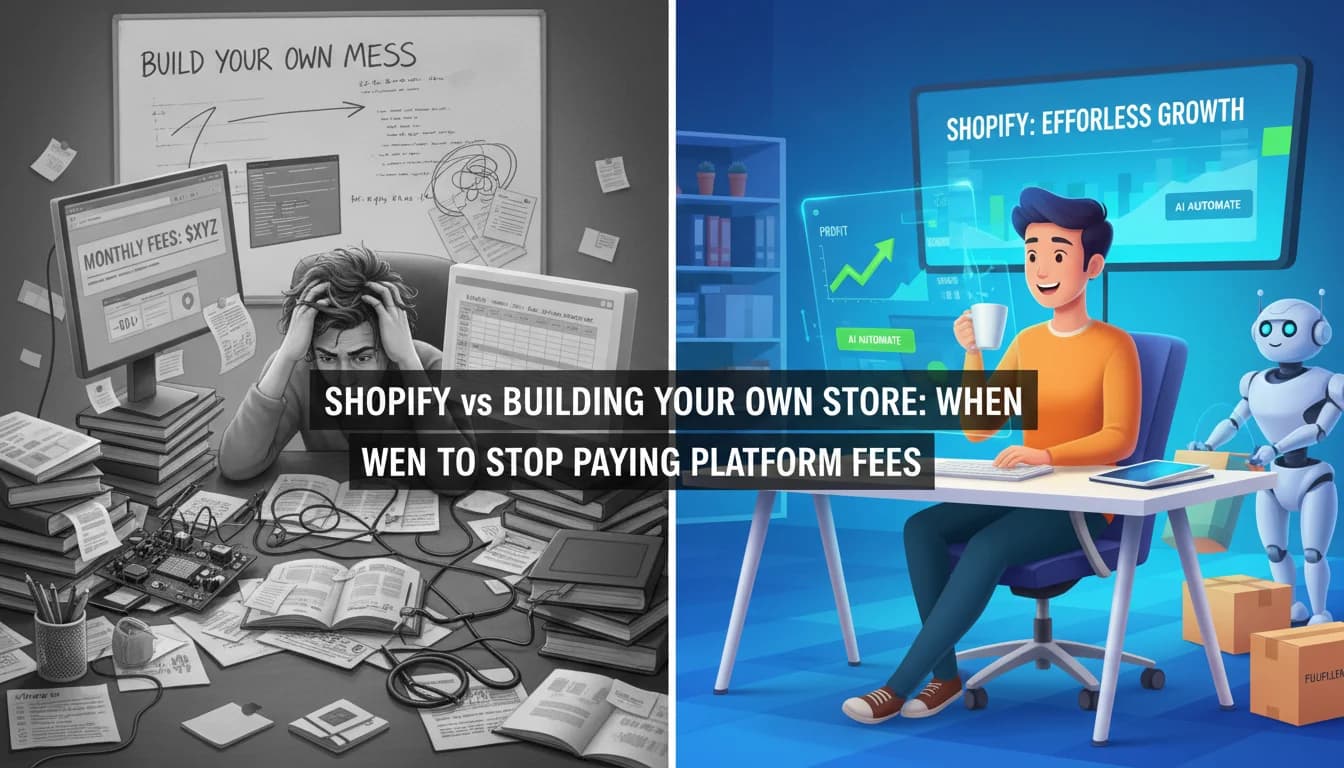
Shopify is the default choice for most people starting an ecommerce store, and for good reason. It is well-built, well-supported, and has been refined over fifteen years into a platform that handles an enormous amount of complexity invisibly. If you have ever set up a Shopify store, you know how fast you can go from nothing to something that accepts real payments. That speed and reliability are genuinely valuable.
But Shopify is also a business with its own financial interests, and those interests express themselves through a pricing structure that grows with you in ways that are easy to underestimate at the start. Monthly fees, transaction fees, app subscriptions, theme costs, and developer fees for customisation are each small on their own. Together, over the course of a year of meaningful revenue, they can add up to a substantial ongoing cost that you are paying whether you like it or not.
This is not an argument against Shopify. It is an argument for understanding exactly what you are paying for and why, so you can make a clear-eyed decision about whether the platform still makes sense at your current stage and revenue level.
What Shopify Is Genuinely Good At
Ecommerce Store Builder
Build it with CodePup AI. Ready in 30 minutes.
Shopify's greatest strength is its ecosystem. The App Store contains thousands of integrations covering everything from shipping and fulfilment to loyalty programs, subscriptions, reviews, and marketing automation. Most of the tools your store will ever need already have a Shopify integration. You connect them with a few clicks and they work. For a store owner who does not want to think about infrastructure, that is a powerful thing.
The platform has also spent years building trust with consumers. Many shoppers feel more comfortable completing a purchase on a Shopify-powered store because they have done it before and it worked. The checkout experience is familiar. The payment security is well-established. That ambient trust is difficult to quantify but real.
- Massive App Store with integrations for virtually every ecommerce tool
- Shopify Payments eliminates transaction fees on the base plan
- Reliable hosting with excellent uptime and global CDN
- Shopify Markets for international commerce and multi-currency support
- Large community of developers and freelancers familiar with the platform
- Built-in fraud analysis and chargeback handling
- POS system for in-person sales that syncs with your online inventory
For a first store, for a store that needs the app ecosystem heavily, or for a store doing international commerce at scale, Shopify's strengths are real and worth paying for. The question is not whether Shopify is good. It clearly is. The question is whether the ongoing cost is justified for your specific situation.
The Real Total Cost of Running a Shopify Store
Most people looking at Shopify see the monthly plan cost first. The Basic plan, the Shopify plan, and the Advanced plan are the headline numbers. But those numbers are only the beginning of the cost picture, and often not even the largest part of it.
- 1Monthly plan fee: ranges from roughly $39 to $399 per month depending on the plan tier, billed annually for a discount
- 2Transaction fees: if you use a payment processor other than Shopify Payments, Shopify charges an additional transaction fee of 0.5% to 2% on every order depending on your plan
- 3App subscriptions: the average Shopify store uses between five and fifteen apps. Most paid apps cost between $10 and $50 per month each. A realistic app stack for a growing store might cost $100 to $300 per month on top of the base plan
- 4Theme purchase: premium themes range from $150 to $400 as a one-time cost, but many themes require paid updates or have limited customisation without developer help
- 5Developer fees for customisation: any change beyond what your theme supports requires a Shopify developer. Hourly rates for experienced Shopify developers range from $75 to $200, and a single custom feature can cost $500 to $5,000 depending on complexity
- 6Email marketing: Shopify Email is included at low send volumes but becomes paid at scale. Many store owners move to Klaviyo, Omnisend, or similar tools, adding another $50 to $300 per month
At $10,000 per month in GMV using a non-Shopify payment processor on the Basic plan, you are paying 2% in transaction fees alone, which is $200 per month before the base fee, apps, or any developer work. At $100,000 per month in GMV, that same 2% transaction fee is $2,000 per month, every month, on top of everything else. The math on transaction fees alone becomes compelling at a certain revenue level.
The total monthly cost of a well-equipped Shopify store in growth mode, including plan fees, apps, email, and occasional developer work, commonly runs between $500 and $1,500 per month. That is $6,000 to $18,000 per year for the privilege of using the platform, before any revenue-based fees.
When Shopify Is Still the Right Choice
There are situations where Shopify's cost is clearly justified and where moving to a custom-code store would be the wrong decision. Being honest about those situations is important.
- You are launching your first store and need the reliability of a proven platform while you validate your product market fit
- Your store depends heavily on specific App Store integrations that would be expensive or time-consuming to replicate outside Shopify
- You are doing significant international commerce and rely on Shopify Markets for currency handling, taxes, and localisation
- You have no technical knowledge and no interest in developing any, and you want every configuration handled through a managed interface
- Your store is growing rapidly and the Shopify ecosystem is a genuine competitive advantage in how fast you can add new capabilities
If any of those situations describe you, Shopify is probably still worth the cost. The fee structure that feels expensive at scale felt invisible when you were starting out, and the value you got from the platform in those early months was real.
When to Consider a Custom-Code Alternative
The moment when switching makes financial sense is different for every store, but there are clear signals that suggest the tradeoff is worth examining. The most common trigger is revenue growth. As GMV grows, the percentage-based costs of transaction fees and revenue-based app pricing grow with it. At some point, a fixed cost to own your own store is cheaper than a percentage-based ongoing fee.
The second trigger is feature frustration. Shopify's template-based customisation has limits. If you find yourself paying a developer every few months to implement something that should be simple, or discovering that a feature you need requires an expensive app that barely does what you want, the platform is creating friction that a custom codebase would not.
- Monthly GMV is high enough that transaction fees represent a significant cost
- Your app stack is growing and the combined subscription cost is substantial
- You are regularly hitting the limits of theme customisation and paying developers to work around them
- You want to own your code and host it wherever makes sense for your business
- You have specific checkout, catalog, or post-purchase features that require expensive custom Shopify development
- You want to use a payment processor other than Shopify Payments without paying a transaction surcharge
What Owning Your Own Store Code Actually Means
When people talk about owning their own store code, the practical benefits are often described in abstract terms. Here is what it actually means in concrete terms. You choose your own hosting provider and pay market rates for hosting rather than a platform premium. You use any payment processor without a transaction surcharge. You modify any part of the codebase without needing a specialist developer for the platform. You are not subject to policy changes or pricing changes by a third-party platform. You can migrate to different infrastructure if something better or cheaper becomes available.
The historical objection to custom-code stores was the cost and time of building them. A custom-built ecommerce store from a development agency could cost $20,000 to $50,000 and take months to deliver. That calculus made Shopify's ongoing fees look very reasonable by comparison. The cost of switching was simply too high.
AI-generated stores have fundamentally changed the build cost calculation. Getting a complete, tested, production-ready store no longer requires months of development or a five-figure agency budget. The gap between Shopify's ongoing costs and the one-time cost of owning your own store has collapsed.
How AI-Generated Stores Close the Gap
The reason custom-code stores were historically the domain of well-funded businesses was simple: they required developer time, and developer time is expensive. An AI builder that can generate a complete, functional, tested store from a prompt removes that barrier entirely. You get the code ownership and flexibility of a custom store without the agency fees or the months of development timeline.
CodePup is built specifically for this moment. It generates complete ecommerce stores from a single detailed prompt, with all pages built simultaneously so the store is coherent and consistent from the first delivery. Every generated store includes Stripe payments with webhook support, user authentication so customers can create accounts and track orders, an AI-powered product catalog, event-driven email campaigns built in without needing Mailchimp, a full analytics dashboard without Google Analytics configuration, and an admin dashboard for managing everything day to day.
Before your store is delivered, CodePup runs automated testing across the generated code. Any issue is resolved before you ever see the result. You do not receive a partially broken store that needs debugging. You receive something ready to connect to a domain and start selling.
The total time from writing your prompt to having a live, tested store that accepts real payments is under thirty minutes. There are no monthly platform fees because you own the code. There are no transaction fees beyond Stripe's standard processing rates. There are no app subscriptions for features that are already built in. The math is straightforward: at any meaningful revenue level, the savings over a comparably equipped Shopify store pay back the cost of the build very quickly. After that, every month you own your own store is a month you are not paying a platform fee for something you already built.
Ready to build this?
Start with a template built for your use case.
Ecommerce Store Builder
Launch a full ecommerce store in under 30 minutes. Describe your products once and CodePup generates the catalog, cart, Stripe checkout, order emails, and admin — tested before delivery and yours to own. No Shopify app stack, no monthly platform lock-in.
Start building →AI No-Code Website Builder
Build any website without writing a single line of code. CodePup AI generates production-ready websites from your prompt — complete with Stripe payments, user authentication, analytics, and event-driven emails, all tested and launch-ready.
Start building →AI Online Store Builder
Launch your online store in minutes. CodePup AI builds your product catalog, shopping cart, Stripe checkout, and customer account portal — fully tested and ready to sell from day one.
Start building →More from the blog
Ready to build with CodePup AI?
Generate a complete, tested website or app from a single prompt.
Start Building