SEO Is No Longer Enough: Why Websites Need AI Search Visibility
Rajesh P
April 16, 2026 · 7 min read
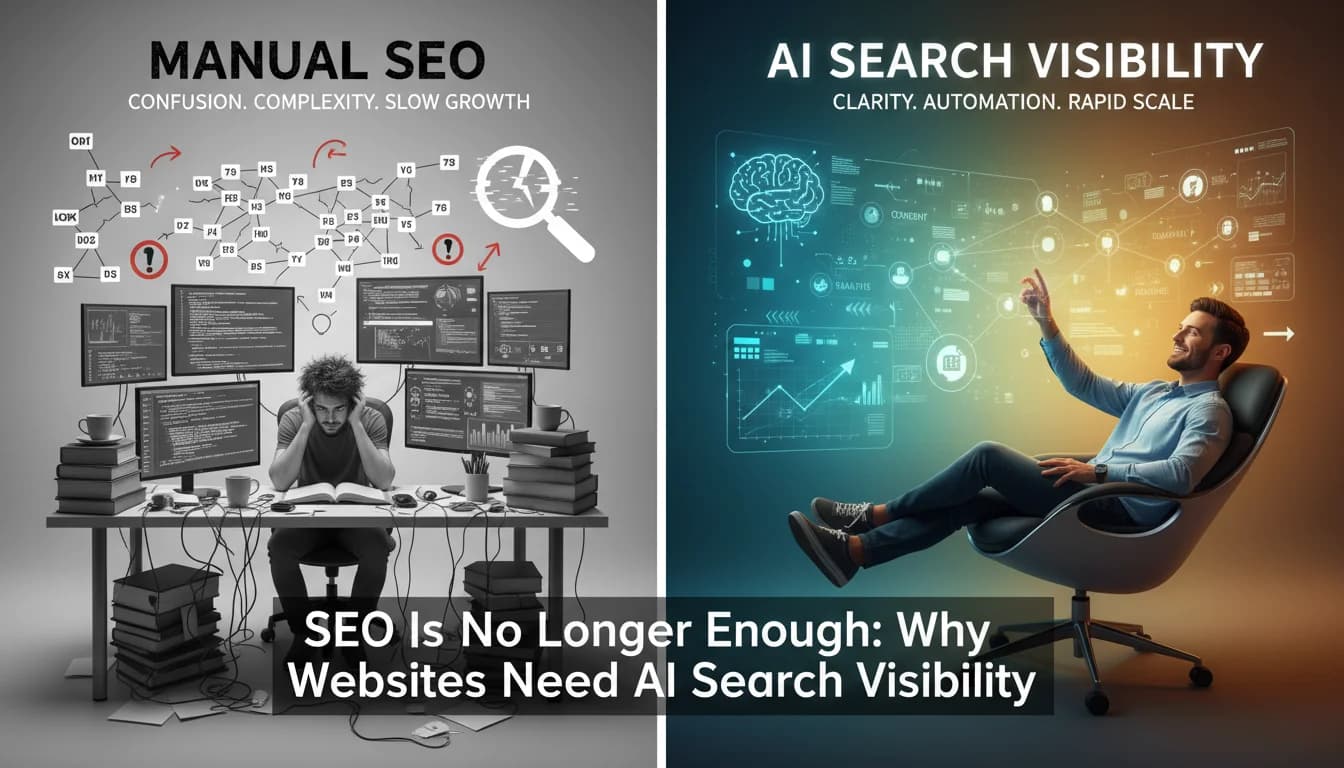
Someone is deciding which project management tool to buy. In 2020 they would have opened Google, typed a few queries, and scrolled a list of blue links and paid ads. In 2026 they open ChatGPT and type one sentence. The answer comes back as a paragraph with three recommendations and a short comparison. The blue links never get opened.
That shift is not a theory. Adobe found that 77% of ChatGPT users treat it like a search engine, 24% go there first before anything else, and 36% have already discovered a new product or brand through the platform. If your website was built to rank on Google but cannot be read cleanly by an AI system, a growing share of potential customers will never find you.
AI search visibility is what closes that gap. It is how you make sure your site shows up on traditional search results and inside the answers AI tools give when a buyer is trying to pick between options.
What AI Search Visibility Actually Means
Measure your AI search visibility
See how you rank in ChatGPT, Perplexity, and Gemini.
AI search visibility is the ability of your website and content to be understood, surfaced, and cited by AI systems. Traditional SEO helps your site rank in a list of results. AI search visibility helps your site become the answer itself. When a user asks an AI tool to recommend a project management app for a remote team, the brands that appear in the response are the ones the model could confidently read, parse, and summarise.
A site can look polished on the surface and still be invisible to these systems. Beautiful hero sections do not help if the underlying HTML is a tangle of styled divs with no structure. Slick animations do not help if product information is locked inside images with no alt text. The parts that matter to AI are mostly the parts that a human visitor never directly sees.
77% of ChatGPT users treat it like a search engine. 36% have discovered a new product or brand through it. 47% of marketers already use it to promote their business, and two in three plan to expand that in 2025. (Source: Adobe)
Why a Polished Site Can Still Be Invisible
A lot of modern website tools make it easy to ship something quickly that looks great in a demo. Speed is good. What is not good is mistaking speed for readiness. A site that went live in an afternoon often has no structured data, no clean heading hierarchy, no metadata worth reading, and no semantic markup that tells a parser what anything on the page actually is.
When an AI system crawls a page like that, it sees visual noise without meaning. It cannot tell what the product is, who it is for, what problems it solves, or how it differs from the three other brands the user is comparing. The model moves on. A competitor with a less striking but well-structured site gets cited instead. This is the shift from website generation to website readiness, and it is the reason the surface layer alone stopped being enough.
The Foundations AI Tools Look For
The things that make a site readable to AI systems are the same things that have always made a site readable to any careful crawler. There is no secret list. What has changed is the cost of ignoring them. In pure Google SEO, weak structure could be partly made up for with backlinks and domain authority. In AI search, if the model cannot parse your content, the authority does not matter.
- Clear page structure with a logical heading hierarchy from H1 through H3.
- Semantic HTML that names elements by purpose, not just by style.
- Descriptive metadata on every page, written for both humans and machines.
- Structured data in JSON-LD for products, articles, FAQs, and organisations.
- Performance that lets crawlers actually reach, render, and index every page.
- Content organised around specific questions buyers ask rather than generic keyword stuffing.
None of these foundations are new ideas. They are the technical hygiene that good web developers have always cared about. The difference now is that every item on that list directly decides whether your site shows up inside an AI-generated answer or quietly gets left out of it.
What This Means for Agencies and Brands
For agencies, there is a real opportunity sitting in plain sight. Most clients have websites that were built for visual impact and never upgraded with AI discovery in mind. The agency that can deliver sites with the right technical spine stands out from the long list of builders that stop at the design layer. It is a cleaner pitch than competing on pixel-level polish alone, and it maps to a problem clients are starting to feel in their own analytics.
For brands, the calculation is simpler. If 36% of ChatGPT users have already found a new brand through the tool, and your site is not readable by it, you are conceding a meaningful share of your acquisition funnel before any campaign has run. The cost to fix this is small compared to the cost of being invisible for another year while the behaviour pattern keeps spreading.
The next competitive moat is not how the website looks. It is whether machines can actually read it.
How CodePup Builds for AI Search Visibility From Day One
CodePup generates complete, production-ready websites with the technical foundations built in from the first pass. Every page ships with proper semantic HTML, a clean heading hierarchy, descriptive metadata, and JSON-LD structured data for the content types that matter for a given industry. You are not retrofitting SEO onto a template three months after launch. The site comes out of the generator ready to be read by Google and by the AI tools people are using alongside it.
The same discipline applies to performance and content structure. Pages are built with crawlability in mind rather than as an afterthought. Content blocks sit inside logical sections with clear purpose instead of decorative containers stacked for effect. When a buyer asks an AI system about your category, the model has something real to work with when it reaches your pages. That is the difference between a site that launches fast and a site that is actually ready for how people search now.
If your site was built to look good in a demo but not to be read by AI, you are losing visibility every day. The CodePup AI Search Audit measures exactly how your brand ranks in ChatGPT, Perplexity, Gemini, Claude, and Copilot today, plus a prioritized list of fixes. Join the waitlist to get your first audit when early access opens.
Ready to build this?
Start with a template built for your use case.
More from the blog
Ready to build with CodePup AI?
Generate a complete, tested website or app from a single prompt.
Start Building