Answer Engine Optimization: Why Most Sites Are Invisible to AI
Rajesh P
April 16, 2026 · 7 min read
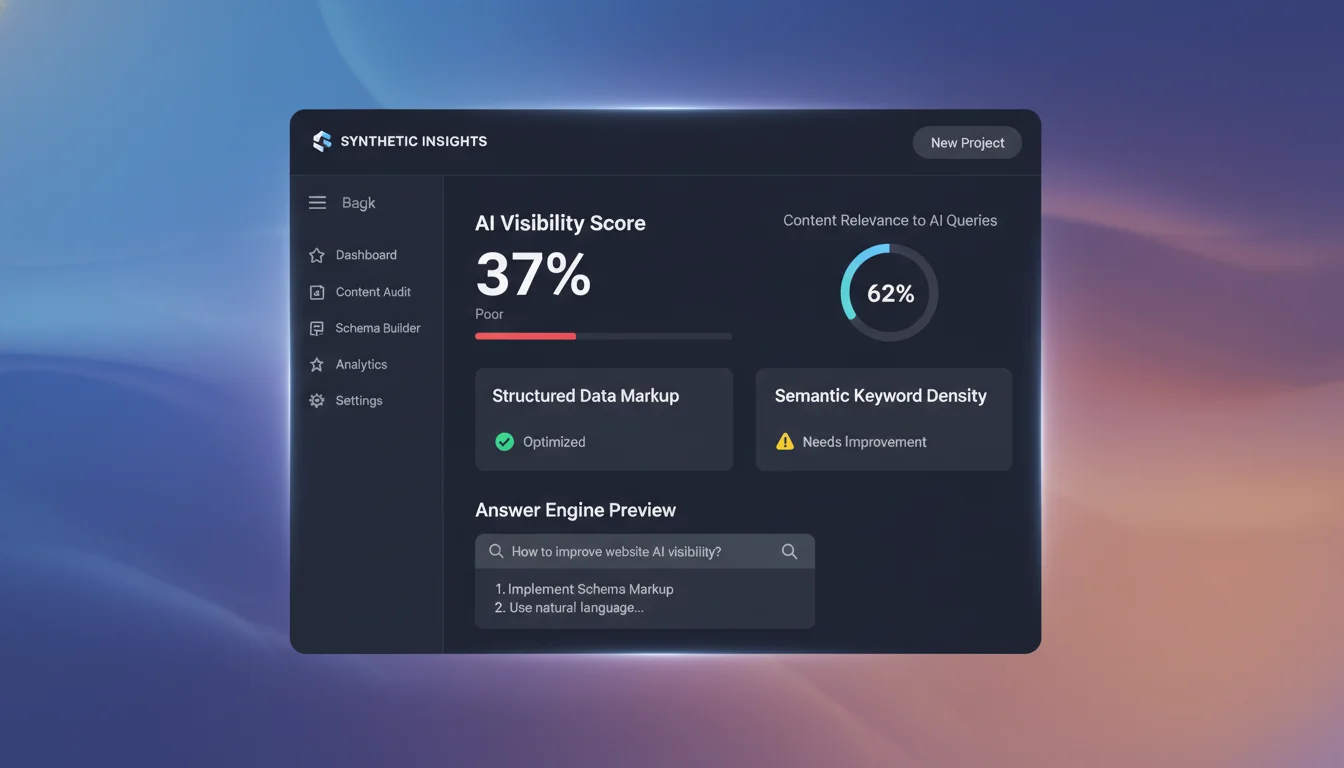
A buyer is deciding which accounting tool to pick for her new agency. She opens ChatGPT. She types one sentence describing the problem. The model comes back with three recommendations and a short comparison. Her old habit of opening Google and scrolling through ten articles never happens. Answer engine optimization, or AEO, is the reason some brands get mentioned in that answer and others do not.
That buyer is already one in four of the people your brand is trying to reach. Adobe's 2026 AI and Digital Trends report, based on a survey of 4,000 customers and 3,000 executives, found that a quarter of customers now use AI-powered platforms as their primary source for information, purchase decisions, and recommendations. That puts AI ahead of brand websites and online reviews in the way people actually discover things. Search behavior has already moved. Most sites have not.
The organizations that catch up first will be the ones that treat AEO as a real discipline rather than a side project. The ones that wait are going to spend the next two years wondering where their pipeline went.
What Answer Engine Optimization Actually Is
Measure your AI search visibility
See how you rank in ChatGPT, Perplexity, and Gemini.
Answer engine optimization is the practice of structuring a website so that AI systems can parse it accurately, extract the information that matters, and cite it inside the answers they generate. It overlaps with traditional SEO but the goal is different. SEO tries to rank your page inside a list of results. AEO tries to make your page the thing a model quotes when it writes the answer itself.
The mechanics are less about keywords and more about clarity. A language model reading your site is effectively doing a comprehension test on it. If the page has clean headings, well-structured content blocks, descriptive metadata, and schema that labels what each thing is, the model can use it. If the page is a collage of decorative divs with product facts buried inside images, the model will skip to a competitor that is easier to read.
The Readiness Gap Adobe's 2026 Data Just Exposed
The Adobe report surfaces a number that should sit uncomfortably with most marketing teams. Only 13% of organizations say they have embedded AI organization-wide for brand discovery and search, which Adobe specifically defines as optimizing content so that it is interpreted and surfaced effectively by AI-powered discovery tools. Just 54% are even preparing to do that work. Close to half of all brands have no active program for being found inside an AI answer at all.
Only 13% of organizations have organization-wide AI investment in brand discovery and search. Just 54% are preparing to optimize content for AI-powered discovery tools. One in four customers already use AI as their primary source for finding products and recommendations. (Adobe 2026 AI and Digital Trends report)
This is where smaller operators have an unusual advantage. An enterprise that has to align a CMS roadmap, a customer data platform, and a content operations team across five regions will spend quarters catching up to AEO. A solo founder or small agency shipping a fresh site this week can start with AEO baked in from the first line of code. The ceiling to join that top 13% is lower than it looks if you are building from scratch rather than retrofitting a site that launched in 2019.
What a Site Needs to Win in AEO
The foundations are concrete and testable. If you are working with a developer or a site generator, these are the things to actually check for before you decide the site is ready for how people search now.
- Semantic HTML that labels elements by what they are (headings, sections, articles, lists) instead of hiding every element inside generic divs.
- JSON-LD structured data for the content types an AI system needs to classify, including Organization, Product, Article, FAQ, and BreadcrumbList.
- A clean heading hierarchy on every page, with a single H1 and logical H2 and H3 nesting that mirrors the content structure.
- Descriptive metadata that answers who the page is for and what problem it solves, not generic brand boilerplate.
- Content written as specific answers to specific questions, because that is the unit of information an AI model extracts and cites.
- Performance budgets that let crawlers reach every page quickly, because pages that are slow to render often get dropped from the index entirely.
None of these items are new inventions. They are the same technical hygiene that has separated good sites from mediocre ones for a decade. The difference in 2026 is that the cost of neglecting them now shows up not in Google rankings but in whether a model includes you in its answer at all. And a buyer who did not see your name in the answer is a buyer who never reached your site.
How CodePup AI Builds AEO-Ready Sites From Day One
CodePup generates production websites with the AEO spine built in from the first pass. Every page ships with proper semantic HTML, a clean heading hierarchy, descriptive metadata, and JSON-LD schema for the content types that matter for the business you described. You are not editing a template three months after launch to retrofit structured data. The site comes out of the generator already speaking the language AI discovery tools need to read it.
That matters most for the people the Adobe readiness gap would otherwise leave behind. A non-technical founder launching a SaaS product does not have the time or the team to run an AEO audit across 40 pages. An agency delivering a client site in a week does not have room to hand-craft schema on every product. CodePup handles that layer so the output is ready to be read by Google and by the AI tools buyers are asking in the same session. You ship with the defaults of the top 13%, without having to build a 40-person CX team to get there.
Half of your future buyers are already asking AI tools before they ever see your brand. The CodePup AI Search Audit shows you exactly where you rank across ChatGPT, Perplexity, Gemini, Claude, and Copilot, plus the gaps your competitors are winning. Join the waitlist to get your first audit when early access opens.
Ready to build this?
Start with a template built for your use case.
More from the blog
Ready to build with CodePup AI?
Generate a complete, tested website or app from a single prompt.
Start Building