How Agencies Can Deliver More Websites Without Hiring More People
Rajesh P
March 30, 2026 · 7 min read
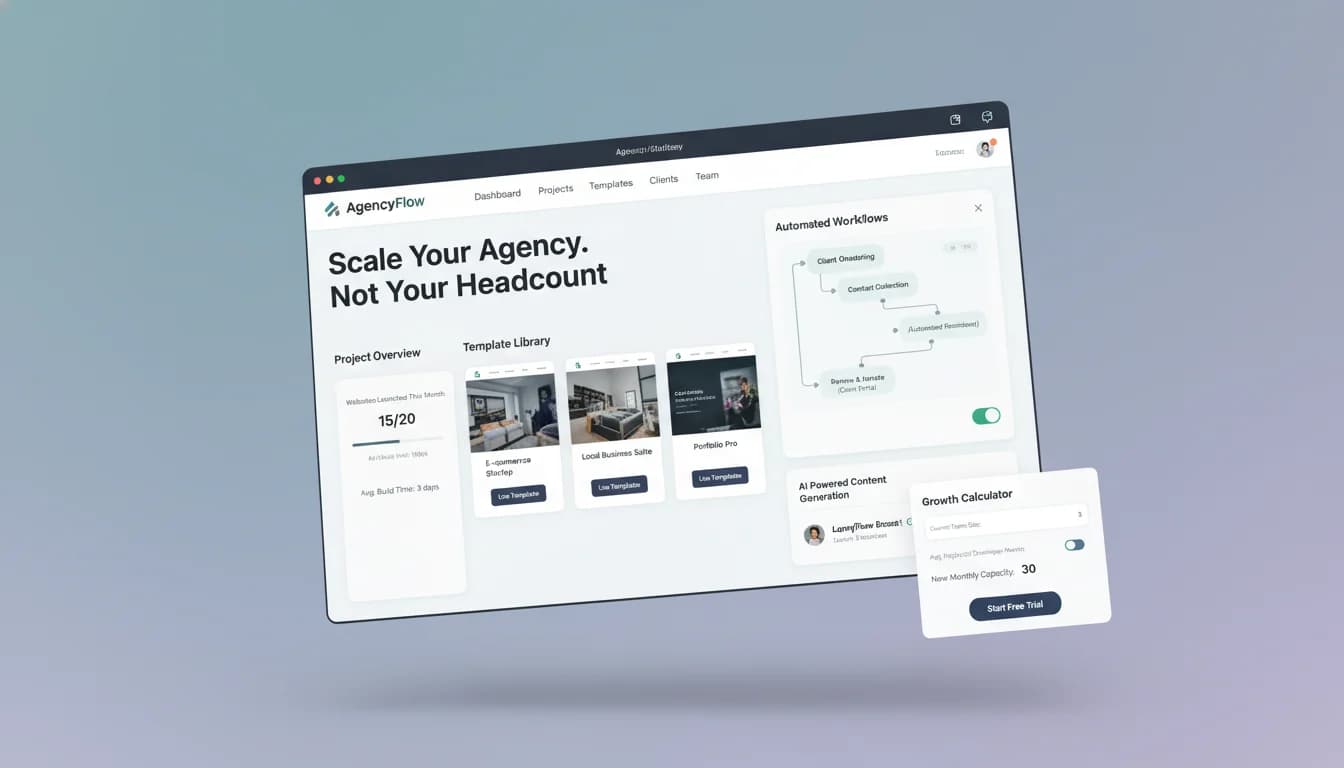
One capable developer can build roughly three to four standard websites a month. Clear briefs, reasonable client feedback cycles, no production emergencies. To deliver eight websites a month, you hire two developers. To deliver sixteen, you hire four. Revenue scales, but so do salaries, management overhead, onboarding time, and the coordination complexity that comes with a larger team. At some point you're running a large agency to do work that a small team should be able to handle.
AI-assisted generation has changed this calculation. But not in the simple way most people assume. The question isn't just 'how fast can AI generate a website?' It's 'where does agency delivery time actually go, and which of those places does AI generation affect?' When you map the actual bottlenecks, the picture is more nuanced and more actionable.
Where Agency Delivery Time Actually Goes
Ask agency owners where delivery time goes and the answers are consistent. The initial build is a smaller fraction of total hours than most people expect. It's everything after the first build, the revision cycles, the QA, the handoff, the client training, the fixes after launch, that consumes the majority of time billed.
AI Agency Website Builder
Build it with CodePup AI. Ready in 30 minutes.
Revision loops are the largest single time sink. A client reviews the first build, provides feedback, changes are made, a second review happens, more feedback comes in, changes are made again. A typical project involves two to four revision rounds. Each round requires developer time to implement, QA time to verify nothing broke, and project management time to coordinate. On a standard project, revision cycles easily account for 40 to 60 percent of total hours.
Manual QA is the second largest cost. Before anything goes to a client, someone needs to test it. Click every link. Submit every form. Test the mobile layout. Try the checkout on Android and iPhone. Run it on Safari. Check that confirmation emails arrive. For a five-page site, this takes two to three hours done properly. For a ten-page ecommerce store, it takes a full day. And it still misses things.
Handoff errors are the third. The developer builds the site, writes documentation, hands it to the account manager who reviews it before sending to the client. Something is always missing or unclear. The client finds a bug in the first hour. The developer has moved on. The context switch cost is real.
The delivery bottleneck isn't building websites. It's everything after the first version: revisions, QA, re-QA after revisions, and the back-and-forth handoff. These are the hours that don't scale. They're exactly where AI generation and automated testing make the biggest difference.
Where AI Generation Removes Steps
AI website generation reduces the time from brief to first deliverable from days to minutes. A brief that would previously take a developer two days of focused work to produce a first draft now takes an hour of prompt refinement and a generation run. The first deliverable the client sees is ready faster, which means feedback comes in faster, which compresses the overall timeline.
The more significant impact is on revision depth. When a client sees the first build quickly, they give higher-quality feedback. They're in the project mindset. The details are fresh. The feedback is about what they actually want rather than trying to reconstruct their original intent from memory three weeks after the brief was written. First-round feedback is more actionable, which means fewer revision rounds overall.
AI generation also eliminates a category of revision entirely: the technical implementation revision. A developer building from scratch sometimes makes layout or component choices the client didn't want. Those choices need to be undone and rebuilt. When generation follows a detailed brief closely, the initial output is much closer to the client's mental model, and the revisions that remain are refinements rather than fundamental changes.
The QA Problem That AI Generation Doesn't Automatically Solve
Here's where many agencies using AI generation hit an unexpected wall. The generation is fast. The first deliverable looks good. But someone still needs to test it. Every form. Every page. Every interactive element. Every mobile layout. Every confirmation email. That manual QA burden hasn't gone away. It's just shifted earlier in the process.
Agencies that use AI generation but still rely on manual QA find they've sped up the build but not the delivery. The QA step that previously happened before handoff now needs to happen before the client sees the first draft, because sending an untested AI-generated site to a client is a fast way to lose that client's trust. AI-generated code, like any generated code, can contain functional issues that are invisible on the surface. Forms that don't submit. Confirmation emails that don't send. Checkout flows that break on mobile.
Agencies that have genuinely changed their delivery economics are the ones that combined AI generation with automated testing. When testing is automated, the generated site is verified before it leaves the agency. The QA step no longer consumes developer or account manager time. The first thing the client sees has already passed its quality checks.
What the Workflow Looks Like When Both Are Automated
The full workflow when generation and testing are both automated: the account manager takes the brief and converts it into a structured prompt. The prompt runs. The site is generated and automatically tested, every page loaded, every button clicked, every form submitted, every checkout completed, every confirmation email verified. Any issues found during testing are resolved before delivery. The site is packaged and sent to the client for review.
The time from brief to client-ready first draft is now measured in hours, not days. The developer, if one is involved at all, is reviewing the output and handling specific customisations that require human judgment. Not rebuilding from scratch. Not spending a full day on QA.
The workflow shift: Brief, generate, auto-test, client review. Four steps with minimal human hours between the brief and the client seeing something real. Compare to the traditional workflow: brief, design, build, internal review, manual QA, revisions, re-QA, client review.
What This Means for Delivery Capacity
Agencies that have made this workflow shift report delivering two to three times as many projects per month with the same team. A two-person agency that was delivering four to six sites a month reports delivering ten to fourteen. The constraint shifts from build capacity to account management and brief quality. Those are fundamentally different problems to solve.
The margin impact is significant. When delivery hours per project drop, the effective hourly rate on fixed-fee projects increases. Agencies can take more projects at the same price, increasing revenue with the same team, or maintain the same volume and reduce costs, increasing margin. Most choose a combination.
The client experience also improves. Faster first drafts, tested sites with no launch-day bugs, and tighter revision cycles make the engagement feel more professional. Clients notice. It shows up in referrals.
CodePup's generation and auto-testing is built for this workflow. Briefs become prompts. Generated sites are automatically tested across every page, form, and interactive element before delivery. You hand clients a working site from the first draft. Your team focuses on the work that requires judgment: brief refinement, client relationship, the specific customisations that make each project feel considered. Not QA and rebuild cycles.
Ready to build this?
Start with a template built for your use case.
AI Agency Website Builder
Launch your agency's website in minutes. CodePup AI builds your portfolio, services, case studies, Stripe project payment flow, and client dashboard — with automated onboarding emails that make every new client feel looked after.
Start building →AI No-Code Website Builder
Build any website without writing a single line of code. CodePup AI generates production-ready websites from your prompt — complete with Stripe payments, user authentication, analytics, and event-driven emails, all tested and launch-ready.
Start building →Landing Page Builder
Create a conversion-optimised landing page in minutes. Describe your product and CodePup AI builds a complete page — hero, features, pricing, testimonials, and CTA — fully tested and ready to publish.
Start building →More from the blog
Ready to build with CodePup AI?
Generate a complete, tested website or app from a single prompt.
Start Building