How to Sell Online Without Amazon or Etsy
Rajesh P
February 15, 2026 · 9 min read
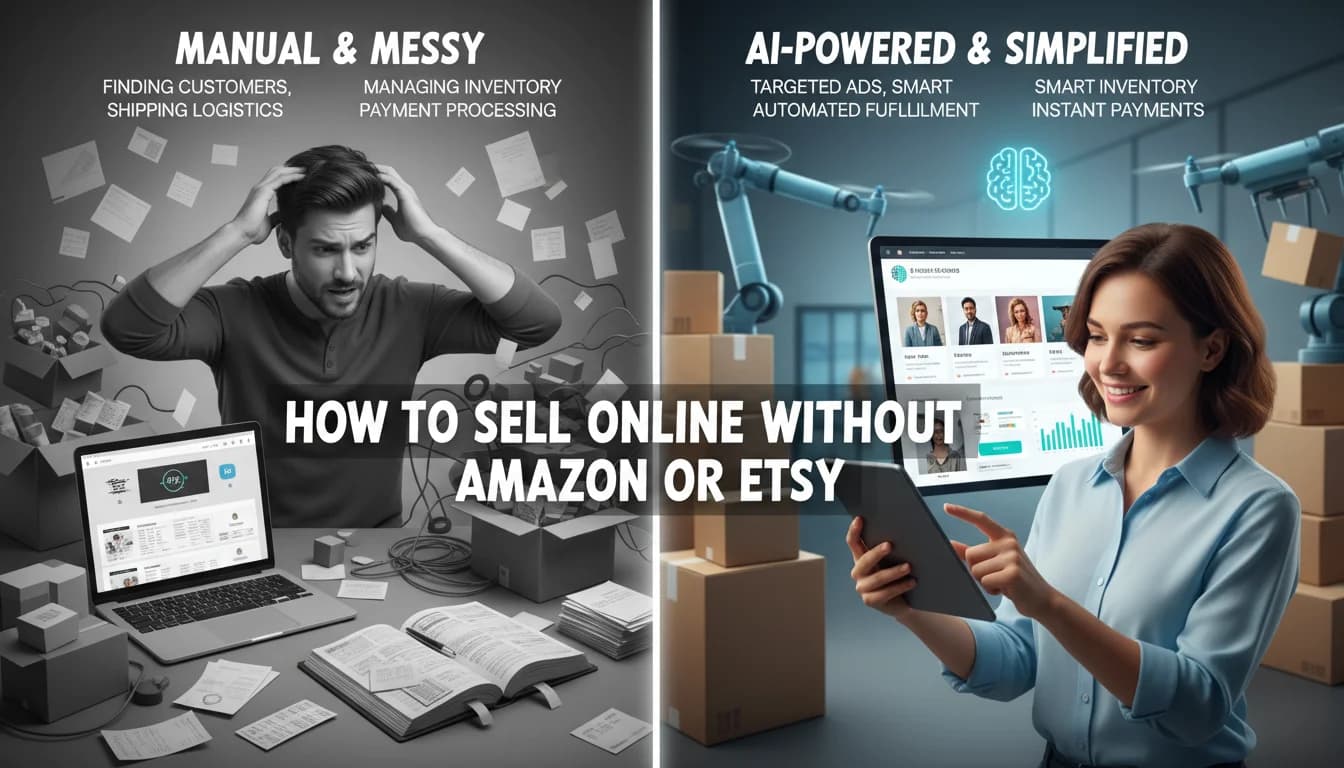
You built your business on Etsy or Amazon. You followed the rules, optimized your listings, collected reviews, and figured out the algorithm well enough to get consistent sales. Then the fees went up. Or a competitor started selling the same thing cheaper. Or a policy change buried your listings overnight. At some point, most marketplace sellers hit the same wall: you have a customer base and a proven product, but the platform owns the relationship. You do not have their email addresses. You cannot reach them directly. If the platform sneezes, your revenue catches a cold.
What It Actually Costs to Sell on Amazon and Etsy
The fee structures on both platforms are designed to be hard to add up, which benefits the platforms. On Etsy, every listing costs $0.20 to post, then renews every four months. When something sells, you pay a 6.5% transaction fee on the sale price including shipping, plus payment processing of 3% plus $0.25. If your shop generates over $10,000 in lifetime sales, you are automatically enrolled in offsite ads and pay an additional 12% on any sale that came through one of Etsy's external ad placements. Add Etsy Plus at $10 per month if you want customization tools, and a fairly active shop is often operating at a total effective fee rate of 18 to 22 cents on every dollar before you have bought a single supply or paid for shipping.
Amazon is structured differently but the math is similarly painful for small sellers. Referral fees run 8 to 15% depending on your category. If you use Fulfillment by Amazon, you are paying per-unit and per-pound storage fees on top of that. And unlike Etsy, where organic discovery is still somewhat possible, Amazon increasingly requires advertising spend to get visibility in competitive categories. A seller who is not putting at least 10 to 15% of revenue back into sponsored ads is often watching their organic rank erode month over month.
Sell Digital Products Online with AI
Build it with CodePup AI. Ready in 30 minutes.
A seller making $4,000 a month on Etsy keeps roughly $2,600 after transaction fees, payment processing, listing fees, and offsite ads. The same $4,000 in revenue through your own store with Stripe for payment processing keeps roughly $3,720, assuming a standard 2.9% plus $0.30 per transaction rate. That is $1,120 more every month, or $13,440 a year, without growing your sales at all.
The Real Reason Sellers Stay on Marketplaces Even When It Hurts
The reasons sellers stay are real, not just excuses. Etsy and Amazon provide something incredibly valuable: built-in buyers who are already searching and already ready to spend. You do not have to generate demand. The platforms also handle payment processing, provide trust signals that convert hesitant buyers, and make setup genuinely simple. For a new seller with no audience and no marketing budget, starting on a marketplace is often the right call. The problem is not starting there. The problem is staying there forever, because the advantages that help you get started become dependencies that limit your growth.
What You Lose When You Only Sell on Platforms
The most valuable thing a direct-to-customer store gives you is customer data, and it is something you simply cannot get from a marketplace. When someone buys from you on Etsy, Etsy owns that relationship. You get the shipping address and that is about it. You cannot email them about a new product, you cannot segment them by purchase history, and you cannot build the kind of repeat purchase rate that makes an ecommerce business genuinely profitable. Beyond that, there is suspension risk. Sellers who have built businesses entirely on Amazon or Etsy have had accounts suspended, sometimes permanently, for policy violations they did not know existed. When your entire revenue stream runs through someone else's platform, you are one decision away from zero.
- You do not own the customer relationship or their contact information
- You cannot build an email list or reach buyers outside the platform
- Account suspension can eliminate your revenue overnight with limited recourse
- You have no brand recognition independent of the platform's trust signal
- Platform fee increases and algorithm changes are outside your control entirely
What You Need to Run Your Own Store Successfully
Running your own store is not technically complicated, but it does require a few things to work properly. You need a storefront with real product pages, including images, descriptions, variants, and a way for customers to search and browse. You need checkout that processes payments through a trusted processor like Stripe, because customers who have not heard of you need a payment method they recognize. You need order confirmation emails that go out automatically, because a customer who pays and hears nothing for 20 minutes will open a dispute. You need some way to bring traffic through SEO, your social following, or email. And you need a simple admin interface where you can manage products and see your orders without needing developer access every time something changes.
How to Make the Transition Without Losing Sales
The most common mistake sellers make is treating this as an either-or decision. You do not have to delete your Etsy listings or close your Amazon storefront on day one. The smarter path is to build your own store first, get it working, and start driving a portion of your traffic there before you reduce your marketplace presence. Start by emailing the customers you do have contact information for. Mention your new site in your packaging. Add a link to your social bio. If you have any buyers who have opted into Etsy messaging, let them know about your direct store. Each customer you move off the platform and onto your own list is a customer the platform can no longer lose for you.
- 1Build your own store while keeping your marketplace listings active
- 2Add your store URL to all packaging, social profiles, and any direct customer communication
- 3Start capturing email addresses from day one on your own site
- 4Offer a small incentive for customers to buy direct, such as free shipping or a modest discount
- 5Gradually reduce your marketplace investment as your direct traffic grows
Sellers who have moved even 20% of their volume to a direct store often report that those customers have a noticeably higher repeat purchase rate. When someone buys from your site rather than your Etsy listing, they remember your brand, not the platform.
How CodePup Gets You to Store Ownership in Under 30 Minutes
The traditional barrier to leaving the marketplaces has always been setup time. Building a proper store with Shopify takes days once you account for theme selection, app installation, payment configuration, and getting your products loaded. CodePup removes that barrier by generating your complete store from a single prompt. You describe your business, your products, and what you need, and CodePup builds every page of the store at once, coherently, with the catalog, checkout, customer accounts, and admin dashboard all generated together as a complete system.
Stripe payments are built in from the start, not added as an app. Customer accounts are included so your buyers can log in and see their order history, which builds the kind of repeat purchase behavior that marketplaces actively prevent. Automated order confirmation and follow-up emails are built in through event-driven campaigns that fire when someone makes a purchase. Every build is tested before it ships to you so the checkout actually works. For a seller who has been paying 20 cents on every dollar to Etsy, getting a complete, functional store live the same afternoon is not just a technical convenience. It is a meaningful change in how much of your own revenue you keep.
Ready to build this?
Start with a template built for your use case.
Sell Digital Products Online with AI
Sell digital products online in minutes. CodePup AI builds your digital storefront with Stripe checkout and automated delivery emails — customers receive their download link the moment payment clears, with no manual work from you.
Start building →Ecommerce Store Builder
Launch a full ecommerce store in under 30 minutes. Describe your products once and CodePup generates the catalog, cart, Stripe checkout, order emails, and admin — tested before delivery and yours to own. No Shopify app stack, no monthly platform lock-in.
Start building →AI Online Course Website Builder
Launch your course platform in minutes. CodePup AI builds your course catalog, Stripe-powered enrollment, student portal with auth, and automated onboarding emails — without the monthly fees of Teachable or Thinkific.
Start building →More from the blog
Ready to build with CodePup AI?
Generate a complete, tested website or app from a single prompt.
Start Building