How to Start an Online Boutique in 2026
Rajesh P
January 2, 2026 · 10 min read
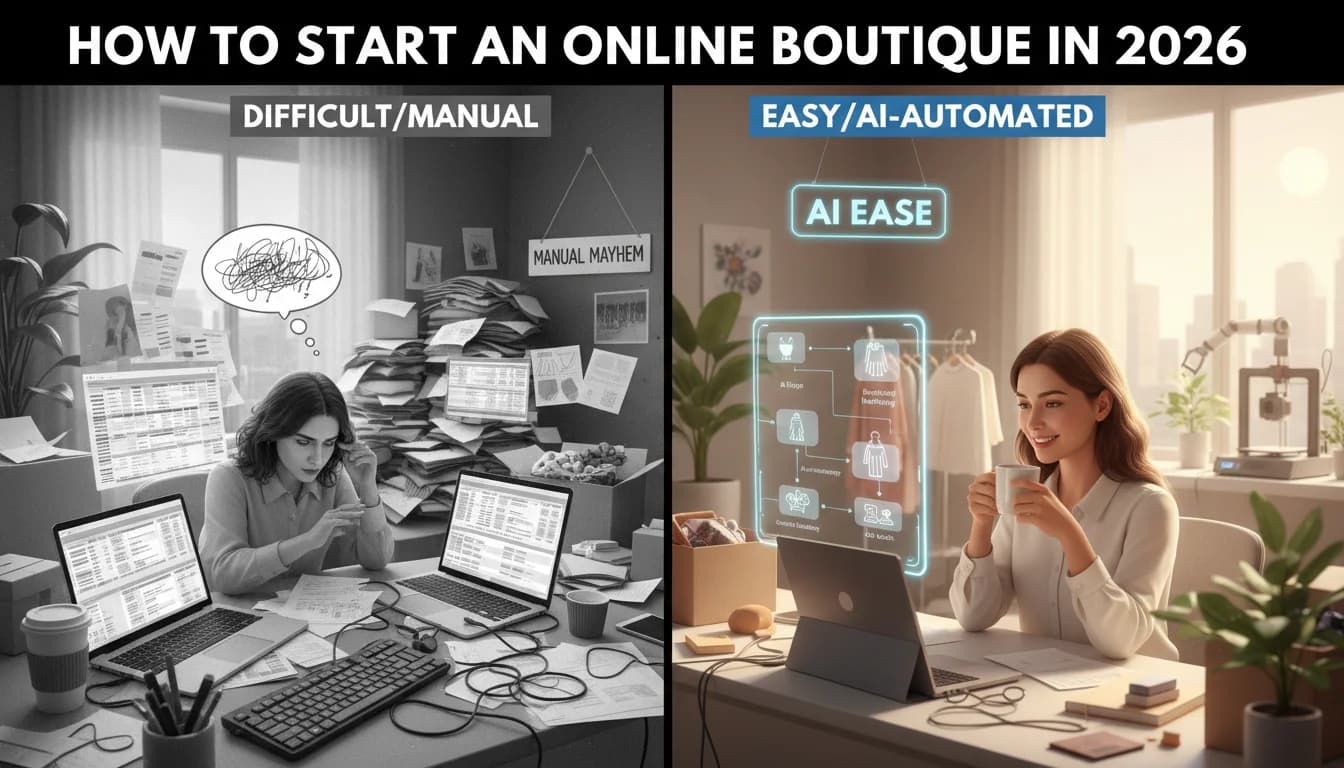
Online boutiques continue to succeed in a market crowded with fast fashion giants, and the reason is not price. It is specificity. A boutique run by someone with genuine taste and a clear customer in mind offers something that no algorithm at Zara or H&M can manufacture: a curated selection that feels like it was chosen for you, by someone who actually shares your sensibility. The boutiques that grow consistently are not trying to compete on scale. They are competing on curation, relationship, and the feeling a customer gets when they find a place that seems to understand exactly what they were looking for.
The Business Model Choices for an Online Boutique
Before you choose a name or pick a platform, you need to decide how you are going to source and fulfill your products, because that decision shapes everything that follows. Buying inventory wholesale means you control quality by handling the product yourself, you can photograph it properly, and you can write descriptions from direct experience. The tradeoff is upfront capital, typically $1,500 to $5,000 for a meaningful first buy, and the inventory risk if pieces do not sell. Dropshipping from fashion suppliers reduces that risk but gives you lower margins, typically 20 to 35%, and less control over the customer experience since you never see what ships. Print on demand is a good model for building brand recognition through branded apparel and accessories, with no inventory risk and decent margins on the right products, but it works better as a supplement to a curated collection than as the foundation of a boutique. Many successful boutiques combine approaches, holding inventory on their proven sellers while using dropshipping to test new styles.
Finding Your Niche and Your Customer
Ecommerce Store Builder
Build it with CodePup AI. Ready in 30 minutes.
The most common mistake a new boutique makes is trying to appeal to everyone. The result is a store that looks like a department store with a smaller selection and higher prices, which is not a compelling offer to anyone. The boutiques that build real followings are the ones that have a very specific customer in mind and make every sourcing, photography, and copy decision with that customer in front of them. Plus-size workwear for women in professional environments. Sustainable kids clothing for parents who care about materials. Occasion dresses for petite women who are tired of getting hemming quotes. Vintage-inspired pieces for women in their 40s and 50s who cannot find their style at fast fashion stores. The more specific you are, the easier everything downstream becomes, from sourcing to social content to the language on your product pages.
The boutiques that grow past $10,000 per month in revenue almost always serve a specific type of woman with a specific style need. Generic women's fashion stores are competing against Zara, Amazon, and Shein on price and scale. Specific stores build communities of loyal customers who return season after season because no one else is serving their particular taste.
Sourcing for a Fashion Boutique
Once you know your customer, sourcing becomes a filter rather than a search. You are not looking for anything that might sell. You are looking for pieces that fit your specific aesthetic and your specific customer's needs. Wholesale marketplaces, both online and at physical trade shows, are the most accessible starting points for new boutique owners. Trade shows like those run in Atlanta, Las Vegas, and New York let you see and touch the product, talk to suppliers directly, and understand minimum order quantities before committing. For a first buy, most wholesale vendors in the apparel space will have minimums ranging from $150 to $500 per style, and buying a small assortment of sizes in three to five styles is a reasonable place to start without overextending on inventory risk. Smaller domestic manufacturers are worth seeking out if your brand positioning involves quality or sustainability, since made-in-the-USA and short-run domestic manufacturing are genuine selling points for certain customer segments.
Building Your Brand Before You Build Your Store
The brand has to exist before the store opens, because the brand drives the store design, not the other way around. A boutique brand is built from a name, a visual identity, a tone of voice, and a presence on the platform where your customer actually spends time. For most fashion boutiques in 2026, that platform is Instagram or TikTok, and ideally both. Before you spend a dollar on inventory or a platform subscription, you should know what your brand feels like, what kinds of images you will share, and what your captions sound like when you write them. Your logo, your color palette, and your visual language should be established before you start building your store, because they will determine every design decision from your banner image to your product page layout. A boutique that has 500 Instagram followers who genuinely love the aesthetic will have an easier first launch week than one that has a fully built store and no audience at all.
- Choose a name that is distinct, memorable, and available as a domain and social handle
- Develop a visual identity with a consistent color palette and font choices before your store launches
- Establish your tone of voice so that your product descriptions and captions feel cohesive
- Start your Instagram or TikTok presence before launch and post regularly to build a pre-launch audience
- Shoot your own product photography with consistent lighting and styling rather than using supplier images
What Your Boutique Website Needs to Convert Browsers Into Buyers
Fashion ecommerce lives or dies on product photography. If your images are inconsistently lit, shot against different backgrounds, or show the product in a way that leaves customers guessing about fit and scale, you will lose sales to uncertainty. The store also needs a size guide that is actually helpful, displayed on every product page rather than buried in a footer link. Your returns policy needs to be visible before checkout, because a customer who cannot find it will assume the worst and abandon the cart. Mobile checkout needs to be genuinely fast, since a significant majority of fashion shoppers browse and buy on their phones. And your product descriptions should sound like a knowledgeable friend describing the piece, not a wholesale catalog specification. Tell the customer how it fits, what it pairs well with, and who it is for.
Product photography is the single highest-return investment a new boutique can make. A $300 afternoon with a photographer who understands fashion will outsell a week of platform tweaking. Customers cannot feel the fabric through a screen, so your images are doing the job a fitting room normally does.
How CodePup Generates a Complete Boutique Store Ready to Take Orders Today
Getting a boutique store that looks good and actually works has traditionally meant either spending significant time in Shopify configuring apps and themes, or hiring a developer at a cost that does not make sense for a new business. CodePup generates your complete boutique store from a single prompt. You describe your brand, your aesthetic, your products, and what you need, and CodePup builds every page of the store together: the homepage, the collection pages, individual product pages with image galleries, the checkout flow, customer account creation and order history, and the admin dashboard, all as a single coherent system.
Stripe checkout is built in so your customers can pay immediately with a trusted payment method. The AI catalog system handles your product listings, variants, and inventory display. Automated order confirmation and shipping update emails go out without you configuring a third-party email tool. The store is mobile responsive by default because it is built from the ground up rather than adapted from a template. Every build is tested before delivery so you are not discovering problems after you have shared your launch post with your Instagram following. For a boutique founder who has the brand, the products, and the audience ready to go, being live and taking orders the same afternoon is a genuine advantage. See the full ecommerce store builder spec for what ships in the generated store.
The Launch Checklist for a New Boutique
Before you announce your launch date publicly, make sure the below is in place. Missing any one of these is the most common reason a first week underperforms expectations, even when the products are good.
- 1Register your business (LLC or sole proprietorship) and obtain a seller's permit in your state if you are selling physical goods
- 2Register a distinct domain name that matches your handle on Instagram and TikTok — brand consistency matters more than cleverness
- 3Finalise your product photography with consistent lighting, backgrounds, and model or flat-lay styling across every SKU
- 4Set up Stripe and a business bank account so payouts flow to a dedicated account, not your personal one
- 5Write product descriptions that cover fit, fabric, sizing, and who the piece is for — not vendor-supplied specs
- 6Publish a shipping and returns policy visible from the footer and linked on every product page
- 7Seed an Instagram or TikTok audience of at least a few hundred engaged followers before opening — your first 48 hours depend on them
- 8Plan your launch-week content: teaser, reveal, and a limited-edition or flash-sale hook to create urgency
Frequently Asked Questions
How much does it cost to start an online boutique in 2026?
A realistic starting budget for a first-time boutique in 2026 is between $2,000 and $7,000. The bulk of that is a first inventory buy ($1,500–$5,000), product photography ($300–$800), a domain and email setup (~$40/yr), and either platform fees (Shopify at ~$29–$79/month) or a one-time prompt-based build. You can start closer to $1,000 if you begin with dropshipping or print on demand, but margins will be tighter and the brand story is harder to build.
What is the best platform for a small online boutique?
Shopify is the default because the ecosystem is mature, but its monthly fee plus app stack adds up. Wix and Squarespace are cheaper for a purely informational site but constrained for a serious boutique. Prompt-based AI builders now generate a full boutique store — checkout, customer accounts, admin — in one pass without the Shopify app-stack sprawl. Which one is right depends on whether you need template flexibility (Shopify), minimum setup cost (Wix), or fastest path to a live store (AI builder). See the ecommerce tool comparison for the tradeoffs.
Do I need a business license to sell clothing online?
In most US states, yes. You will typically need a seller's permit (sometimes called a resale certificate) to buy wholesale and to collect sales tax. Most boutique founders start as a sole proprietor or form an LLC once revenue exceeds a few thousand dollars a month. Check your state's small-business portal — most let you register online for $50–$200. If you sell internationally, you may need to register for VAT/GST in some markets once you cross their sales threshold.
Can I run an online boutique without holding inventory?
Yes — dropshipping and print on demand remove inventory risk entirely. The trade-off is lower margins (often 20–35%), slower shipping, and no hands-on quality control. The most durable boutiques in 2026 start with a small, curated inventory buy for their hero products and use dropshipping only for long-tail or seasonal styles. Pure dropshipping boutiques rarely build loyal communities because the product experience is identical to a dozen other stores running the same supplier.
How do I get my first boutique customers without paid ads?
The fastest first-customer playbook in 2026 is still organic: a consistent Instagram or TikTok presence for 60–90 days pre-launch, a tight niche that gives people a reason to follow, and a launch-week content plan that creates scarcity (a capsule collection, a limited run, or a founder-only early-access list). Paid ads work later, but the first 50–100 customers almost always come from the audience you built before the store opened.
Ready to build this?
Start with a template built for your use case.
Ecommerce Store Builder
Launch a full ecommerce store in under 30 minutes. Describe your products once and CodePup generates the catalog, cart, Stripe checkout, order emails, and admin — tested before delivery and yours to own. No Shopify app stack, no monthly platform lock-in.
Start building →Dropshipping Store Builder
Launch a branded dropshipping website today. Describe your niche and the builder generates a complete store — product pages, cart, Stripe checkout, and supplier-ready layouts for AliExpress, CJ Dropshipping, or Zendrop — fully tested and live in minutes.
Start building →More from the blog
Ready to build with CodePup AI?
Generate a complete, tested website or app from a single prompt.
Start Building